
Cathedral Rock Vortex: The Feminine Heart of Sedona
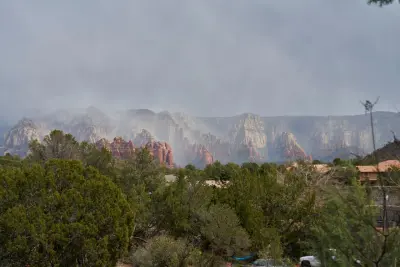
Cathedral Rock is the most photographed formation in Sedona — twin spires of layered red sandstone rising 1,000 feet above Oak Creek, visible from half the town. It is also classified as the strongest feminine inflow vortex of the four primary sites, said in the local tradition to support reflection, grief, and the kind of internal work that the masculine sites at Airport Mesa and Bell Rock are not built for. Reaching the vortex itself requires the hardest hike of the four.
What is a vortex?
The Sedona vortex tradition recognises four primary sites — Airport Mesa, Bell Rock, Cathedral Rock, and Boynton Canyon — classified as either masculine (upflow, activating) or feminine (inflow, reflective). Cathedral Rock is one of the two feminine sites, alongside Boynton Canyon, and is widely described in the local tradition as the most powerful inflow vortex in the area. It is the site spiritual teachers in town most often recommend for grief work, ceremony, or any practice that calls for going inward rather than outward.
None of this is recognised by mainstream geology, and there is no peer-reviewed evidence of unusual electromagnetic activity at any of the four sites. We tell our guests so directly. We also tell them that Cathedral Rock is genuinely worth the climb whether or not the vortex tradition resonates — the saddle between the spires is one of the great sitting spots in the American Southwest, and an hour up there after most of the crowd has descended is the kind of experience that justifies the trip on its own.
Visiting tips — the climb
Reaching the Cathedral Rock vortex requires the hardest hike of the four sites: a 1.2-mile round-trip slickrock scramble climbing 740 feet from the Back O' Beyond trailhead to the saddle between the formation's twin spires. The U.S. Forest Service rates it moderate, which is technically accurate and practically misleading — there is no easy stretch. From the first switchback you are climbing red sandstone steps; halfway up there is a 15-foot near-vertical chute you climb hand-over-hand using natural foot pockets. It is not technical, but it is real exertion and it is hard on dogs and uncomfortable for anyone with serious exposure-anxiety.
The Back O' Beyond trailhead is at the end of a residential street off SR-179. The lot holds maybe twenty cars and is full by 7:30 AM weekends from March through May and again late September through mid-November. Red Rock Pass required ($5 day). When Back O' Beyond is full, park at Yavapai Vista on SR-179 and take the Templeton Trail west — joins Cathedral Rock Trail after 1.7 miles, adds 3.4 round-trip miles, gives you an easy warm-up.
For the full trail breakdown — the chute, dogs, photography spots — see our dedicated Cathedral Rock Trail guide.
Best time to go
Sunrise is the right answer if you want the vortex experience without the crowd. Be on the trail by 5:30 AM in summer, 6:30 AM in winter. The east-facing valley below the saddle lights up first; the formation itself catches sun ten minutes later. You will likely share the saddle with three to five other early risers — all of them quiet, most of them there for the same reason you are.
Sunset is the more popular and more photographed slot. Arrive at the trailhead 90 minutes before sunset to secure parking and finish the climb in daylight; bring a headlamp for the descent because the trail is not waymarked for night use. The saddle gets crowded — twenty to forty people on a Saturday — and the silence the feminine inflow tradition asks for does not really survive that.
Midday in summer is genuinely dangerous — surface temperatures on the slickrock exceed 130°F and there is no shade above the first switchback. Skip the climb between 10 AM and 4 PM from May through September.
Where to feel it strongest
The canonical vortex spot is the saddle itself — the open notch between the twin spires, reached at the top of the scramble. There is space for two dozen people to spread out on the sandstone shelves and find a private vantage. Walk past where the crowd clusters (most people stop at the first viewpoint after the chute) — there are quieter shelves along the south edge of the saddle facing the Verde Valley and along the north edge facing back toward town. Both feel meaningfully different from the obvious lookout.
A faint social trail continues left from the saddle toward the base of the southern spire. The energy practitioners in town often direct clients there specifically — it is more sheltered, the wind drops, and the sandstone forms small natural alcoves. Do not try to climb either of the spires themselves without ropes — they are technical-grade rock and people fall every year.
Practical notes: bring a thin foam pad or a folded jacket (sandstone is hard after ten minutes), bring more water than you think (the climb dehydrates fast), and stay longer than feels comfortable. The fifteen minutes after the crowd starts descending is when the saddle becomes what the vortex tradition promises.
For Visit Sedona's official overview of the four vortex sites, see the Visit Sedona vortex guide.
Stay nearby
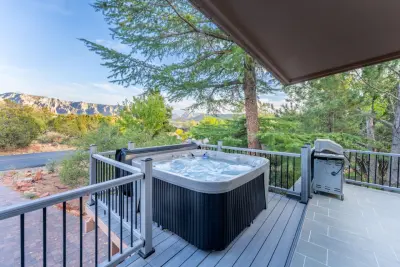
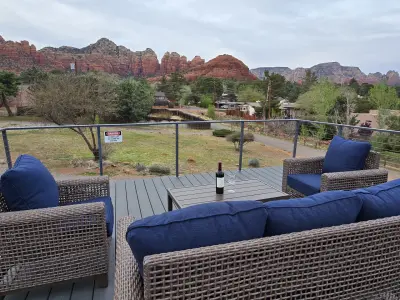
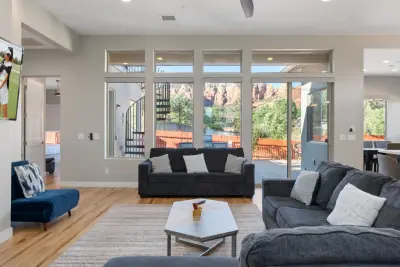
Cathedral Rock sits at the south end of Sedona, off SR-179 between West Sedona and the Village of Oak Creek. Most of our properties are within a 10-to-15 minute drive of the Back O' Beyond trailhead. Browse our Sedona vacation rentals for a home base that puts you on the sunrise trail before 6 AM.