
Summer Monsoon — Cloud Drama & Slot Canyons
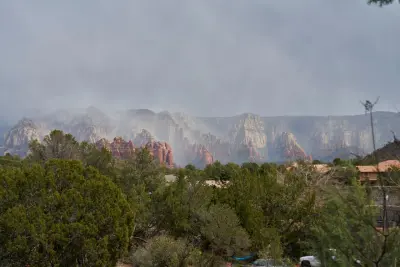
Sedona summers are hot, but the season has a secret: from early July through mid-September the North American Monsoon rolls in, and almost every afternoon a wall of cumulonimbus clouds builds over the Mogollon Rim, drifts south over the red rocks, and breaks into a 30-minute downpour that ends in a rainbow. The cloud drama is some of the most photogenic weather in the Southwest. The trade-off is genuine heat advisory danger before storms break, and very real flash flood risk in any slot canyon when one does. Plan around the rhythm and summer is the most cinematic season Sedona offers.
What to expect
Sedona summer at 4,500 feet is significantly cooler than Phoenix two hours south, but it\'s still hot: July and August daytime highs run 95–100°F regularly, with overnight lows around 65°F. Without the monsoon, summer would be brutal. With it, the days take on a daily rhythm that\'s genuinely beautiful to plan around.
The monsoon cycle: mornings start clear and warm. By 11 AM cumulus clouds begin building over the Mogollon Rim north of town. By 1–2 PM they\'ve grown into towering anvil-topped cumulonimbus drifting south over the red rocks. Storms break between 2 PM and 5 PM, typically running 20–40 minutes of heavy rain with lightning and occasional small hail, then clearing into golden side-light and frequent rainbows by 6 PM. Evenings are clear, cool (down into the 70s), and often spectacular.
Heat advisory warning: the National Weather Service issues heat advisories or excessive-heat warnings on roughly 15–25 summer days each year for the Sedona–Verde Valley area. Surface temperatures on south-facing slickrock between 11 AM and 4 PM exceed 130°F. People are evacuated by Sedona Fire from Cathedral Rock and Devil\'s Bridge every summer for heat-related medical emergencies. This is not a season to underestimate heat — hydration alone will not save you if you\'re on exposed slickrock at 2 PM.
Flash flood warning: the same storms that produce the photogenic afternoon clouds dump 1–2 inches of rain in 30 minutes onto a watershed that drains hard and fast through Oak Creek\'s side canyons. A storm 10 miles north of you can send a wall of water down West Fork or Boynton Canyon under blue skies. Never, ever enter a slot canyon (West Fork, Subway Cave, Soldier Pass\'s lower wash) when monsoon storms are in the forecast within a 50-mile radius — the NWS Flagstaff radar is the tool to check before you start any slot hike from late June through mid-September.
Best hikes for the season
Summer hiking strategy is simple: be off the trail by 10 AM. That means starting at first light — 5:00–5:30 AM trailhead arrival. The early-morning hours are cool, the slickrock hasn\'t cooked, and the rising sun lighting the red rocks is the daily photographic prize.
West Fork of Oak Creek — the right summer hike. Mostly shaded along the creek, flat, the multiple creek crossings actively cool you off. Allow three hours. Critical caveat: only on days with zero monsoon storm forecast. The trail runs through a narrow slot canyon with no high-ground escape route from a flash flood. When in doubt, skip it.
Bell Rock Pathway — flat 3.6-mile loop, doable in early-morning cool. Be at the trailhead by 6 AM; be done by 8:30 AM.
Birthing Cave Hike — short, partly shaded, finishes inside a cool sandstone cave. Good summer pick if you start early.
Cathedral Rock Trail — only at sunrise in summer. The scramble in 100°F afternoon heat on exposed slickrock is dangerous. Start by 5:00 AM, be off the saddle by 8 AM.
Hikes to avoid entirely in summer afternoons: Devil\'s Bridge (fully exposed approach with no shade), Doe Mountain (sun-baked mesa top), Airport Loop (mostly exposed). All four can be done at dawn or skipped until autumn.
Booking + packing tips
Summer is Sedona\'s value season for accommodation. Property rates drop 25–35% from spring peaks; June and early July weeks book at the lowest rates of the year outside January. The trade-off is a daily hiking window that closes by 10 AM, but if you reframe afternoons as pool/hot-tub/Slide-Rock/jeep-tour time, the trip works beautifully.
Pack for serious heat. Lightweight long-sleeve sun shirts (better than tank tops — block UV, wick sweat), a wide-brim hat (not a baseball cap — protect the neck), polarised sunglasses, SPF 50 face/SPF 30 body reapplied hourly, a 2-litre hydration bladder per hiker, electrolyte powder or tablets, light-coloured trail shoes. A small towel soaked in cold creek water and worn around the neck is a real cooling tool. For thunderstorm afternoons: a packable rain shell and waterproof phone pouch. For slot canyons specifically: shoes that can get fully wet, no exceptions.
Plan for Slide Rock. Slide Rock State Park is the right summer afternoon activity — the creek runs cold (60–65°F even in August) and the parking lot management is the only logistical concern. Arrive by 9 AM Tuesday through Thursday; the weekend lot fills before 8 AM. Pack a picnic, swimsuits, water shoes, towels, and a soft cooler.
Photographer\'s tip
The monsoon is the single best photography window of the year in Sedona — the storms create lighting and cloud drama you don\'t see in clear-sky months. The play: be on the rim of a viewpoint 60–90 minutes before sunset on a day when the afternoon storm has cleared. The combination of receding storm clouds, golden side-light, and frequent rainbows over the red rocks is the iconic Sedona summer frame.
Best vantage points for storm photography: the Chapel of the Holy Cross overlook (panoramic eastward view of receding storms over Bell Rock and Castle Rock); Airport Mesa upper saddle (360-degree view, often catches rainbows arcing over Cathedral Rock); Red Rock Crossing on Verde Valley School Road (reflection of Cathedral Rock in Oak Creek with storm clouds above). Bring a polarising filter (saturates the post-storm colours), a wide lens (24mm and wider for full cloud-and-rainbow compositions), and a sturdy stance (monsoon evenings get windy).
Lightning is a real hazard on exposed ridges. If you can hear thunder, you\'re close enough to be hit — descend to vehicle or treeline immediately. Photograph from the parking lot, not the ridge, during active storms. The receding-storm window (30–60 minutes after the rain stops) is the safe and photographically richest moment.
Stay nearby
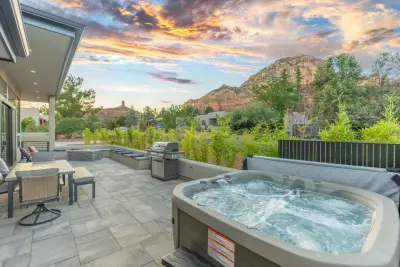
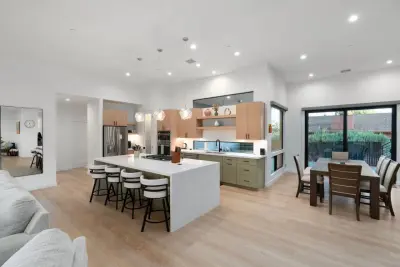
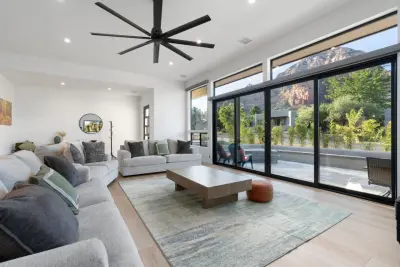
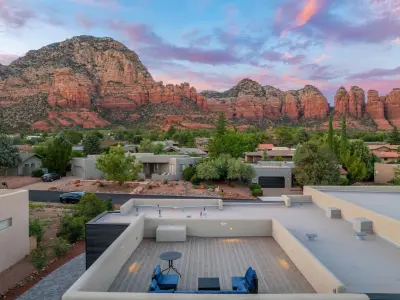
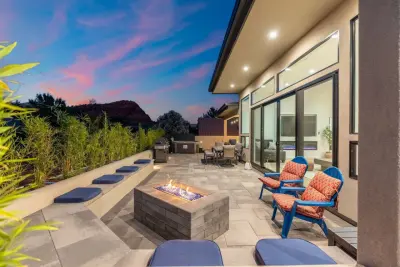
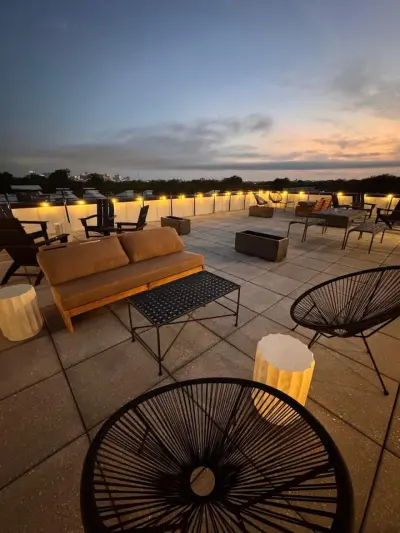
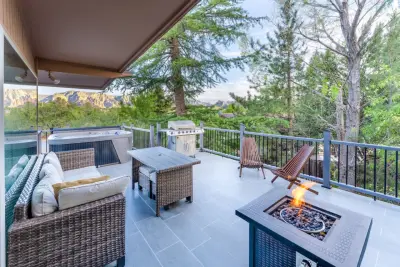
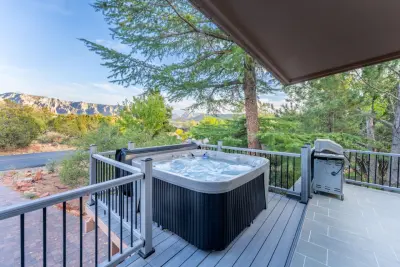
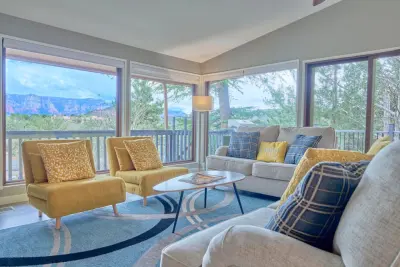
Summer is the right season for rentals with pools, hot tubs, and big shaded patios — somewhere you actively want to spend the 11 AM to 5 PM heat hours. Browse our full Sedona vacation rentals collection with that filter in mind. For Visit Sedona\'s summer trip overview and current trail-condition advisories, see their summer guide.