Amitabha Stupa & Peace Park
Tucked into a residential corner of West Sedona, the Amitabha Stupa & Peace Park is a 14-acre Buddhist site built around a 36-foot stupa — free to visit, open dawn to dusk, and welcoming to visitors of every faith or none.
What it is
The Amitabha Stupa & Peace Park is a 14-acre Buddhist park on the lower slopes of Thunder Mountain in West Sedona, built and maintained by Kunzang Palyul Chöling, a Tibetan Buddhist community. The centrepiece is the 36-foot Amitabha Stupa, consecrated in 2004 and filled, in the traditional manner, with prayers and sacred objects. A smaller White Tara Stupa stands nearby, along with prayer wheels, strings of prayer flags moving in the wind, and short paths and benches threaded through the juniper. It is a rare thing in the American Southwest — a consecrated Buddhist stupa open to the public every day of the year — and, more practically for a visitor, one of the quietest places in Sedona to simply sit.
Is the Amitabha Stupa free to visit?
Yes. Admission is free and the park is open dawn to dusk, every day. Donations are welcomed — the site is maintained entirely by the community that built it — but nothing is charged and nothing is sold. Visitors of all faiths, and of none, are explicitly welcome. On any given morning you will find meditators, photographers, neighbourhood walkers, and people who came up out of simple curiosity, all sharing the hillside without friction.
Getting there
The park sits in a residential corner of West Sedona: from SR-89A, head north on Andante Drive and follow it toward Pueblo Drive, where the small signed parking area sits at the edge of the neighbourhood. From the lot it is a short walk up an unpaved path to the stupa itself — five minutes, gently uphill, fine in ordinary shoes though not stroller-friendly. Because the parking area is small and the setting is a quiet neighbourhood, arrive with the volume down: no music, doors closed softly, voices low.
What to do once you're there
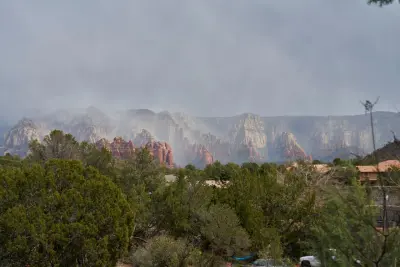
The traditional practice is to walk around the stupa clockwise — once, or three times, or for as long as the walking meditation holds you — and to spin the prayer wheels as you pass. Many visitors simply pick a bench and sit; the site faces the red mass of Thunder Mountain, and the combination of prayer flags, juniper, and sandstone is its own argument for staying a while. Photography is welcome, but keep it unobtrusive when others are meditating, and leave any offerings you find at the stupa undisturbed.
How long do you need?
Thirty to forty-five minutes covers an unhurried visit — the walk up, a slow circuit of the stupa, a few minutes at the White Tara Stupa, and some time on a bench. If you meditate, budget an hour or more; nobody will hurry you. The stupa pairs naturally with a quiet contemplative morning — many guests combine it with an early visit to one of the Sedona vortex sites, which ask for the same unrushed attention. Early morning is the best window: soft light on Thunder Mountain, cool air, and often nobody else on the hill.
Stay nearby
The Peace Park is in West Sedona, a five-minute drive from most of our homes on that side of town — browse our West Sedona vacation rentals for a base you could almost walk from, or see all of our Sedona properties. For broader visitor information, see Visit Sedona.